
Microsoft Copilot is the AI visibility opportunity most brands are sleeping on. It runs on Bing, reaches over a billion Windows users, and sits inside Edge, Microsoft 365, and Teams, woven into the daily workflows where business decisions get made. When Copilot answers a question, it cites real sources with clickable links, and earning one of those spots is more reachable than you might think. Better still, the work pays off well beyond Copilot itself. Here is how Copilot chooses sources, why Bing is the key that unlocks several platforms at once, and how to get your brand cited.
How Copilot Picks Sources
Copilot does not answer from training data alone. When a prompt needs current information, it generates search queries, sends them to Bing, and pulls candidate pages from the Bing index and live web, a process Microsoft calls web grounding. It then ranks those candidates for relevance and credibility, and a language model synthesizes the answer, attaching footnote-style citations to the pages it used. It favors sources that are recent, authoritative, clearly structured, and easy to parse, and it draws on knowledge-graph and structured-data signals where they exist.
One fact sits underneath all of this: Bing is the foundation. Pages ranking in Bing's top results are far more likely to be cited, and if you are invisible in Bing, you are invisible in Copilot. The catch is that Bing rankings often differ from Google's, so this is not something your Google strategy handles for you. It needs checking on its own.
How Copilot grounds an answer
You ask
A prompt that needs current information.
It queries Bing
Microsoft calls this step web grounding.
Bing returns
Candidate pages from the index and live web.
It ranks and writes
Ranked for relevance, then an LLM drafts the answer.
It cites
Footnote-style links to the pages it used.
The Bing Multiplier
Here is why Copilot deserves more attention than it gets. Because Copilot draws from Bing, and because a large share of ChatGPT's search citations also match Bing's top results, optimizing for Bing can earn you visibility across Copilot, ChatGPT, and traditional Bing search at the same time. One body of work, three surfaces. Bing's US search share is at its highest ever, and yet most teams still treat it as an afterthought, submitting sitemaps only to Google and never checking their Bing position. That gap is exactly the opening. For the ChatGPT side of this equation, see our guide to how to get cited by ChatGPT, which leans on the same Bing-driven retrieval.
The Bing multiplier: one effort, three surfaces
Microsoft Copilot
Grounds its answers in the Bing index.
ChatGPT search
Most citations match Bing's top results.
Bing search
Classic organic visibility, directly.
The Enterprise Angle
There is a dimension to Copilot that goes beyond public web search, and it is one of the most underused opportunities in AI marketing. Microsoft 365 Copilot is used across the vast majority of Fortune 500 companies, which means your public web content can surface inside enterprise workflows, the documents, research, and procurement decisions happening behind company walls. For B2B brands, that is a direct line to decision-makers who never typed your name into a search bar. Copilot reaches hundreds of millions of Edge and Microsoft 365 users on top of its Windows footprint, so the audience is both large and commercially serious.
How to Optimize for Microsoft Copilot
Turn the mechanics into a plan.
Get Visible in Bing First
Everything starts here. Verify your site in Bing Webmaster Tools, submit your sitemap, and check your Bing rankings separately from Google, since many sites discover they rank well on one and barely register on the other. Without Bing visibility, the rest of this list cannot help you.
Use IndexNow
IndexNow lets you instantly notify Bing when pages change, so updates can be seen and cited within hours rather than after a slow crawl cycle. Google does not currently support it, but for Copilot it is a real advantage, especially for time-sensitive content like launches, news, and frequently updated pages. Verifying Bing Webmaster Tools, submitting your sitemap, and turning on IndexNow take well under an hour and open visibility across multiple platforms.
Structure for Easy Extraction
Copilot rewards content it can lift cleanly. Phrase H2 headings as the questions people actually ask, and make the first sentence under each a direct answer before you expand. Question-and-answer pages, FAQ sections, and comparison tables map neatly onto how Copilot assembles responses, which makes your content easier to quote.
Add the Right Schema
Structured data helps Copilot understand and trust your pages. The types that matter most are Organization, Article, FAQPage, and HowTo. Implemented accurately, they clarify what your content is and how it should be read, and they feed the structured-data signals Copilot draws on.
Prove Real Expertise
Experience, expertise, authority, and trust count here as they do on Google. Content from identifiable authors with demonstrated expertise gets cited more, so add real author bios, cite credible sources with links, and include original data, case studies, and first-hand experience. Generic staff-writer bylines actually work against you in both Bing's ranking and Copilot's source selection, so put real names and credentials forward.
Mind Microsoft's Trust Signals
Microsoft places heavy weight on security, and that shows up in Copilot. Serve everything over HTTPS, set proper security headers, and display your trust signals plainly. An insecure site or one throwing mixed-content warnings sends a negative signal that counts against you specifically in Microsoft's ecosystem. Pair that with fresh content and clear internal links from your articles to their pillar pages.
Your Bing-first setup for Copilot
| Action | Why it matters for Copilot |
|---|---|
| Verify in Bing Webmaster Tools | Confirms Bing can see your site, the baseline for everything else |
| Submit your sitemap | Gets your pages discovered and indexed in Bing |
| Turn on IndexNow | Updates seen and citable within hours, which Google cannot match |
| Add Organization, Article, FAQPage, HowTo schema | Feeds the structured-data signals Copilot draws on |
| Serve HTTPS with proper security headers | Microsoft weighs security heavily in source selection |
| Use real, credentialed author bios | Generic staff bylines work against you in Bing and Copilot |
Stop treating Bing as an afterthought. Verify your site in Bing Webmaster Tools, turn on IndexNow, and publish structured, expert-authored, secure pages. Because the same Bing index feeds Copilot and ChatGPT, that one effort buys visibility across several of the platforms that matter.
A Real Example
We hold ourselves to this. Ask Microsoft Copilot for the best generative engine optimization in Indonesia, and Arfadia is named in the answer. We earned that the way this guide lays out: solid Bing visibility, structured question-and-answer pages with accurate schema, named expertise and original data, and clean, secure technical foundations, all crawlable for Bing. You can see the result in our portfolio, where the same query surfaces Arfadia across the major AI engines, Copilot included. The lesson is that the Microsoft side of AI search rewards exactly the brands that bother to show up there properly.
 Arfadia cited by Microsoft Copilot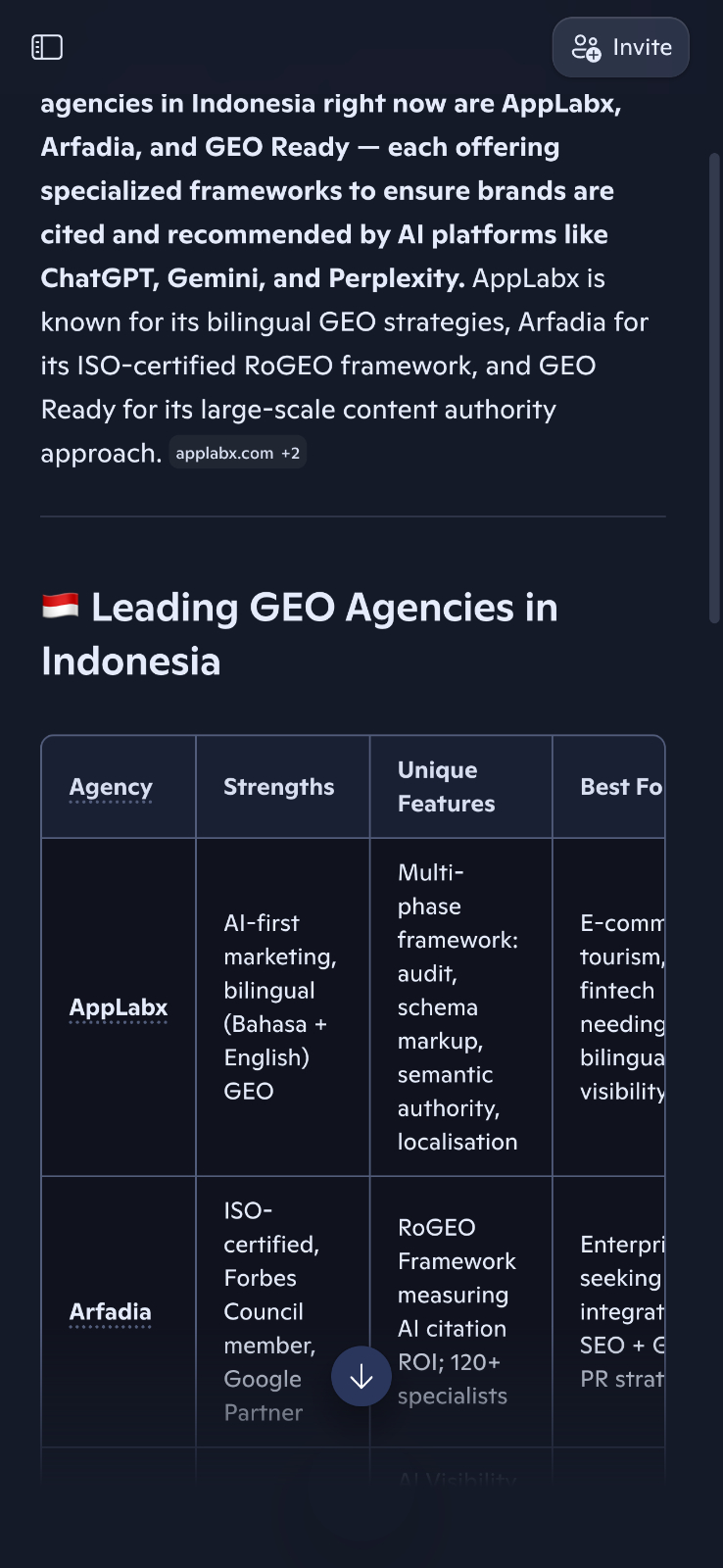
Common Mistakes to Avoid
A few habits keep brands out of Copilot's answers. The biggest by far is ignoring Bing, treating it as a rounding error when it is the gateway to Copilot and a chunk of ChatGPT too. Closely related is assuming your Google rankings carry over, when the two indexes and algorithms are different and need checking separately. Generic staff-writer bylines hurt, since Copilot rewards identifiable expertise. Serving an insecure site, or one with mixed-content warnings, sends a trust signal that works against you in Microsoft's world specifically. Skipping IndexNow leaves easy, fast indexing on the table. And publishing unstructured walls of text, with no clear questions, answers, or schema, gives Copilot nothing clean to cite. Cover Bing, structure, expertise, and security, and most of the problem solves itself.
How to Track Your Copilot Citations
Microsoft now offers a useful window into this. The AI Performance report in Bing Webmaster Tools shows how often your site is cited in AI answers, how many pages get cited, and, most valuably, the grounding queries, the actual user questions that triggered citations from your content. That lets you reverse-engineer what Copilot is pulling you in for. Its limits are real, though: it covers only Copilot, and it does not show brand mentions or which competitors appear alongside you. So pair it with a cross-engine AI visibility tool, which we cover in our best AI visibility and GEO tools guide, with the tracking shown in practice in our hands-on PromptWatch review.
Copilot runs on Bing, but other assistants source their own way. See how to rank in Perplexity and how to get cited by Claude, and read the full method in our complete AI visibility guide.
The Bigger Picture
Copilot rewards the brands willing to take Microsoft seriously: visible in Bing, structured for extraction, backed by real expertise, and built on secure foundations. The payoff is unusually efficient, since the same Bing groundwork surfaces you in Copilot and ChatGPT alike, and the enterprise reach puts you in front of buyers inside Fortune 500 workflows. That is generative engine optimization aimed at the most overlooked corner of AI search, strengthened by genuine experience and authority signals, and set in context by our complete AI visibility guide. The latest citation statistics show how fast this shift is happening.
Frequently Asked Questions
How does Microsoft Copilot choose which sources to cite?
Copilot generates search queries from a prompt, retrieves candidate pages from Bing's index and the live web, ranks them for relevance and credibility, and uses a language model to synthesize an answer with footnote-style citations. It favors recent, authoritative, clearly structured pages and uses structured-data signals where present.
Is optimizing for Copilot the same as optimizing for Bing?
Bing is the foundation. Pages ranking in Bing's top results are far more likely to be cited by Copilot, so getting visible in Bing comes first. Copilot then weighs additional factors like structure, expertise, and credibility on top of that ranking.
Does optimizing for Bing help with other AI platforms?
Yes. Because Copilot uses Bing's index and a large share of ChatGPT's search citations also match Bing's top results, strong Bing optimization can earn visibility across Copilot, ChatGPT, and traditional Bing at once. It is one of the most efficient moves in AI search.
What is IndexNow and should I use it?
IndexNow lets you instantly tell Bing when pages change, so updates can be cited within hours instead of after a slow crawl. Google does not currently support it, but for Copilot it helps, especially for time-sensitive content. Setting it up alongside Bing Webmaster Tools takes well under an hour.
Why does the enterprise angle matter for Copilot?
Microsoft 365 Copilot is used across most of the Fortune 500, so your public web content can surface inside enterprise research and procurement workflows. For B2B brands, that puts your content in front of decision-makers who never ran a public search, a reach few other engines offer.
Do trust and security signals affect Copilot citations?
Yes, more than on most engines. Microsoft weighs security heavily, so serve everything over HTTPS, set proper security headers, and display trust signals. An insecure site or mixed-content warnings count against you specifically within Microsoft's ecosystem.
How can I track my Copilot citations?
Use the AI Performance report in Bing Webmaster Tools, which shows citation counts and the grounding queries that triggered them. Since it only covers Copilot and omits brand mentions and competitors, pair it with a cross-engine AI visibility tool for the full picture.
About Arfadia
PT Arfadia Digital Indonesia is a full-service digital marketing agency operating since 2008 and Indonesia's Generative Engine Optimization pioneer since 2023. We help brands earn citations in Microsoft Copilot and across AI engines every day. Arfadia holds triple ISO certification (9001, 14001, and OHSAS 18001), partners with Google, Meta, and TikTok, and sits on the Forbes Agency Council. Explore our generative engine optimization services.