
Most tool reviews are written by people who opened a free trial, clicked around for an afternoon, and called it research. This one is different. We run Arfadia on PromptWatch every day. It is the platform we use to track how our own agency shows up across ChatGPT, Gemini, Perplexity, and the rest, and it is the tool we lean on to do the same for clients. So this is a hands-on review, built on real dashboards and real numbers, not a press release rewrite.
Short version: PromptWatch is our pick for the best all-around AI visibility and generative engine optimization tool in 2026. Here is the long version, with the evidence.
An all-in-one AI visibility platform that tracks more than ten engines, benchmarks you against competitors, and helps you act, all with transparent self-serve pricing.
What Is PromptWatch?
PromptWatch is a platform for measuring and improving how your brand appears inside AI-generated answers. It runs your chosen prompts across a wide set of engines, captures every response, and tells you how often you show up, where you get cited, how the sentiment reads, and how you stack up against rivals. Think of it as rank tracking for the AI era, except instead of ten blue links, you are tracking your share of the answer itself. It pairs that monitoring with tools to close the gaps it finds, which is what separates it from trackers that only report.
How We Use PromptWatch at Arfadia
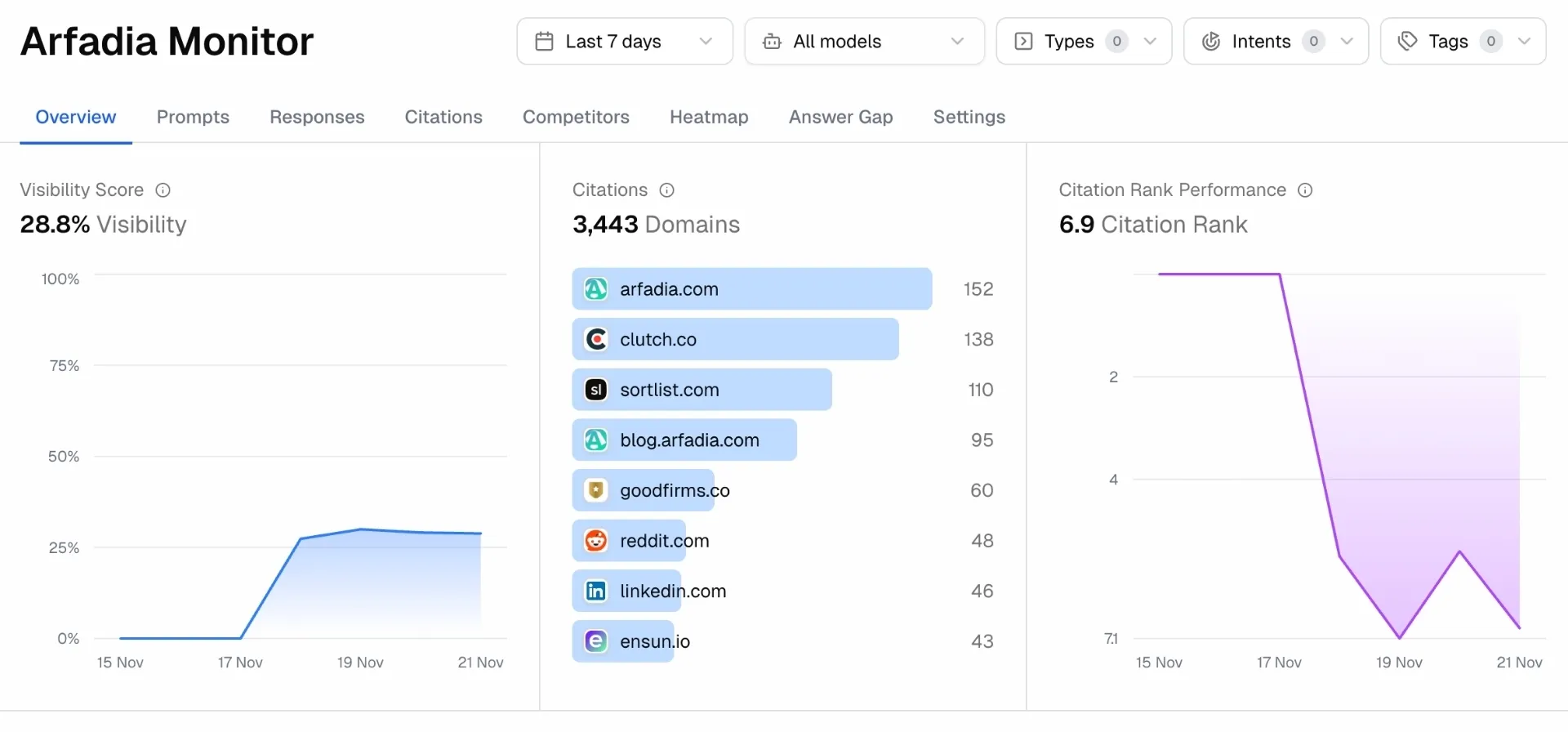
Here is the part no affiliate site can fake. We keep a live project called Arfadia Monitor running inside the tool. In one recent snapshot it tracked 20 prompts across more than ten AI engines, from ChatGPT and Gemini to Perplexity, Grok, Microsoft Copilot, DeepSeek, and Google's own AI Overviews and AI Mode. That single project had logged 662 responses, with a visibility score of 28.8%, 228 brand mentions, and a citation rank of 6.9. On the citation side, it was watching 3,443 domains, led by arfadia.com with 152 citations and blog.arfadia.com with 95, alongside third-party directories like Clutch, Sortlist, and GoodFirms, plus Reddit and LinkedIn.
That mix tells a story on its own, and we will come back to it. The point for now is simple: we did not skim this tool, we live in it.
The Features That Matter
PromptWatch packs a lot in. These are the parts we actually use, and why each one earns its place.
Visibility Score and Overview
The Overview is the daily pulse check. One visibility percentage, the trend line behind it, your top citation domains, and your citation rank, all on one screen. We glance at it every morning. When the number moves, we already know where to look next.
Heatmap: Per-Engine Competitor Benchmarking
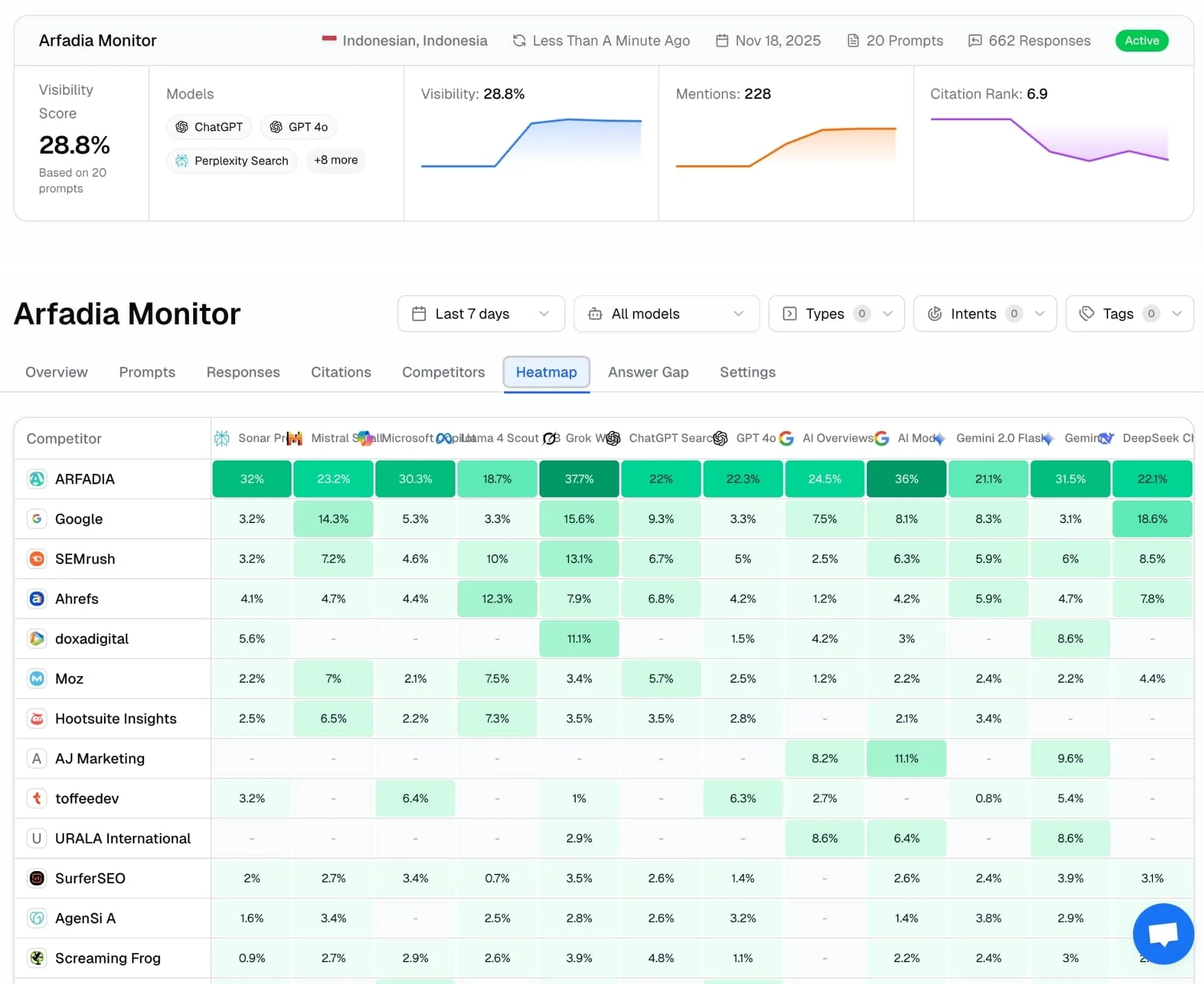
This is the view we open most. The Heatmap lays every competitor in rows and every AI engine in columns, then fills each cell with a visibility share. It makes strengths and gaps obvious at a glance. In our project, Arfadia sits dark green across the board, leading on Grok at 37.7%, AI Mode at 36%, Microsoft Copilot at 30.3%, and Sonar Pro at 32%, well ahead of the SEO platforms and local agencies in the same grid. If a rival suddenly spikes on one engine, you see it the same day.
Responses: Every Answer, Scored
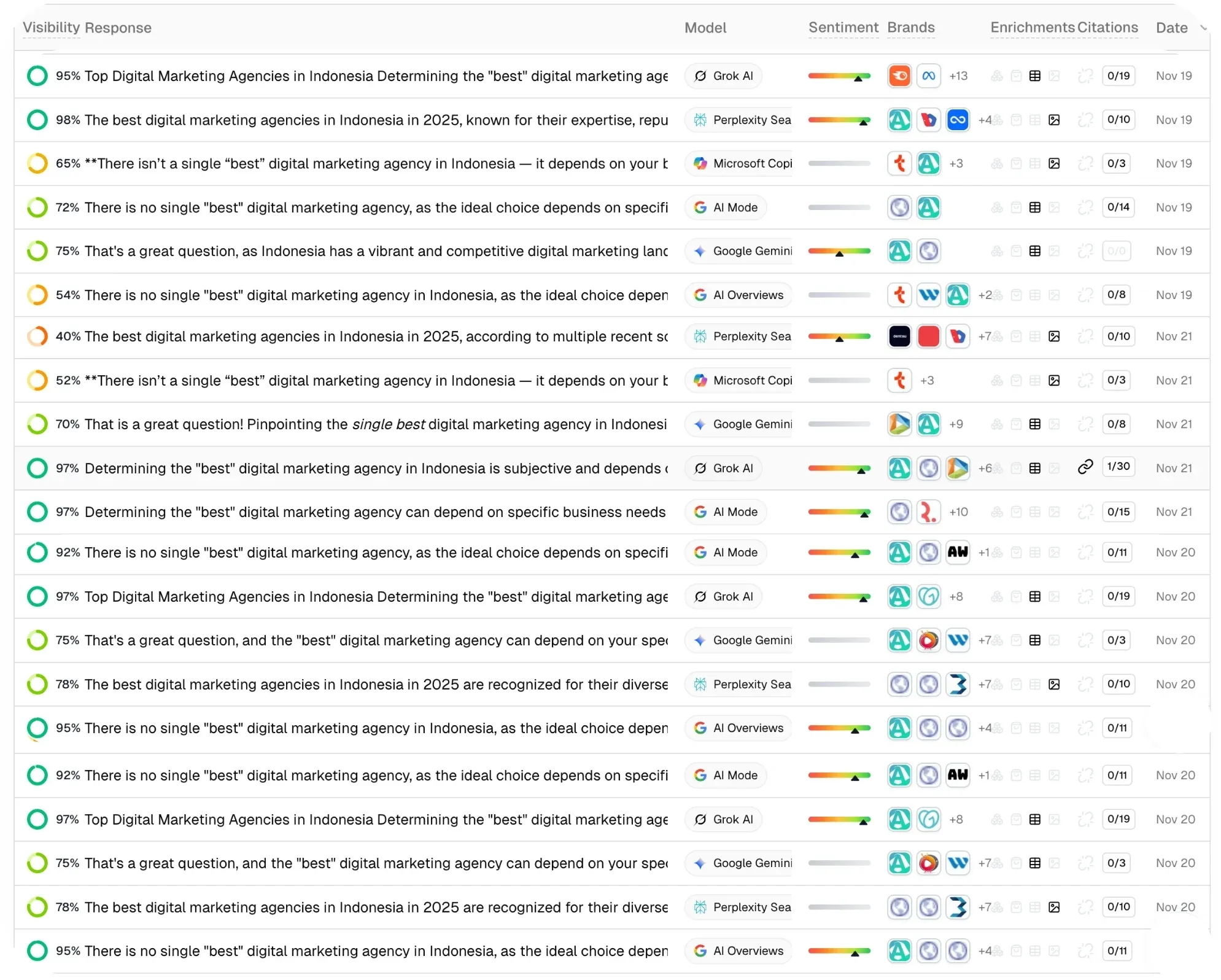
The Responses tab is the granular layer. Every individual AI answer is captured and scored for visibility, tagged with the model that produced it, run through sentiment analysis, and checked for which brands and citations it contained. You can read exactly what ChatGPT or Gemini said about your category, on which day, and whether you made the cut. When a client asks "but what is the AI actually saying about us," this is the receipt.
Prompts and Prompt Details
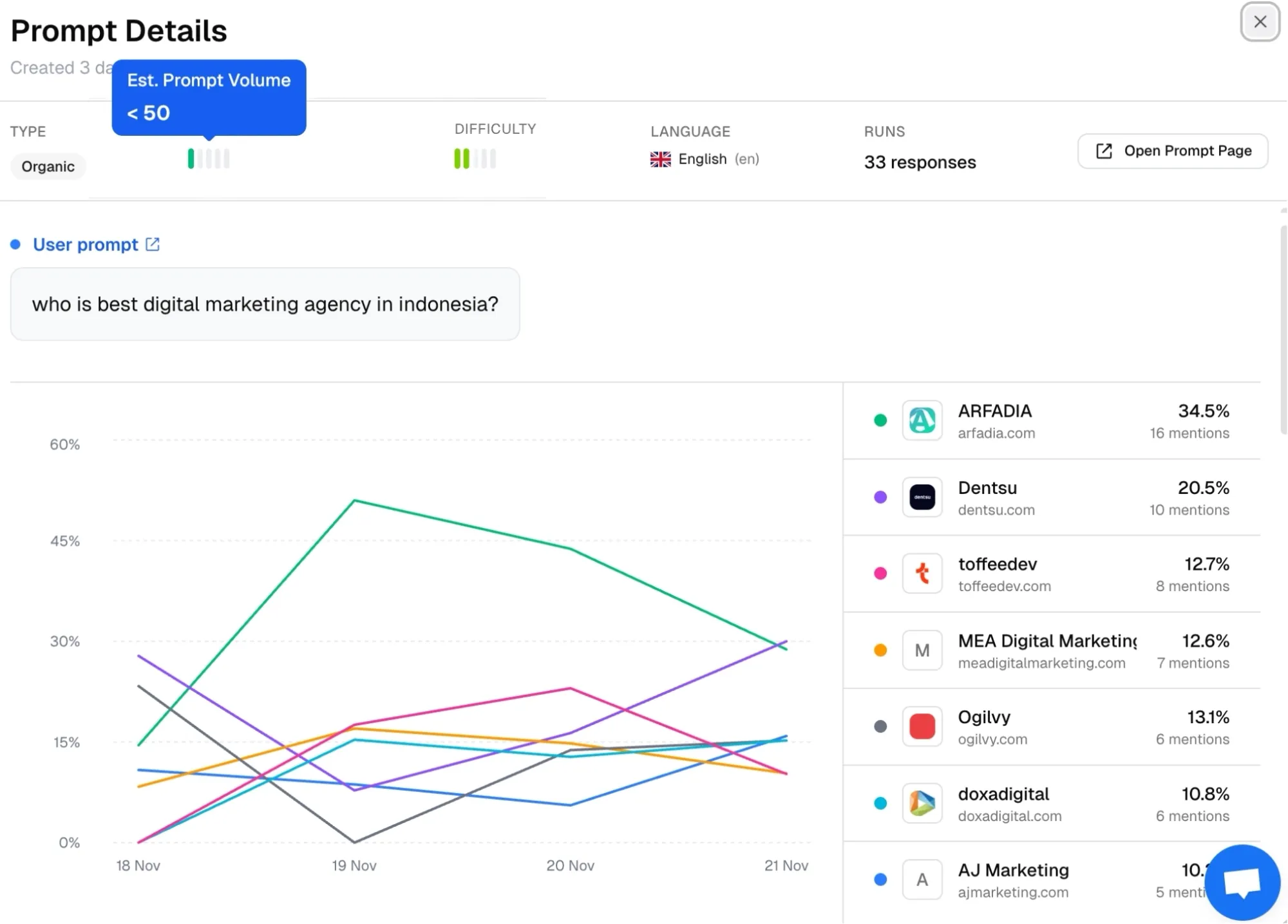
Drill into any prompt and PromptWatch shows its estimated prompt volume, a difficulty rating, language, and a full share-of-voice breakdown over time. For the prompt "who is best digital marketing agency in indonesia?" our project logged 33 responses, and the breakdown put Arfadia first at 34.5% with 16 mentions, ahead of Dentsu, Ogilvy, toffeedev, MEA Digital Marketing, and doxadigital. Seeing the named competition, ranked, for a specific buyer question is exactly the intelligence that used to be impossible to get.
Citations, Competitors, and Answer Gap
Citations shows which domains AI engines pull from when they build answers in your space, ranked by volume. Competitors tracks the rivals you care about over time. Answer Gap surfaces the prompts where you are missing from the answer entirely, which is the fastest shortlist of where to publish next. Together they turn vague "we should do GEO" energy into a concrete to-do list.
Getting Started and Ease of Use
Setup is straightforward. You create a project, add the prompts you want to track, pick your engines and your market, then let it run. Results start filling in within a day, and the morning Overview becomes a habit fast. There is a learning curve, since the tool does a lot, but the layout is clean and nothing is buried. Within a week we were reading the Heatmap and Answer Gap without thinking about where to click. For a platform this deep, that is a win.
What We Found in Our Own Data
Living in the tool taught us a few things that a feature list never would.
First, the share-of-voice data above is the kind of proof that changes a sales conversation. For the question buyers actually ask AI, Arfadia leads, ahead of global names. We could not have shown that a year ago.
Second, the citation domains were a lesson in strategy. Our own pages, arfadia.com and blog.arfadia.com, drove the most citations, but right behind them sat directories like Clutch, Sortlist, and GoodFirms, plus Reddit and LinkedIn. That lines up with the wider research on where AI pulls from, which we cover in our AI citation statistics, and it confirmed we needed both strong owned content and a presence on the third-party sources AI trusts.
Third, the citation rank wobbled across the week. It is a useful reminder that AI citations are volatile by nature, and that being cited once is never the finish line. Without a tool watching daily, that drift goes unnoticed until it costs you.
Pricing
PromptWatch keeps pricing public, which we appreciate after dealing with quote-only enterprise tools. Plans run from around $99 a month up to about $579 a month across tiers, with a 7-day free trial and more seats unlocked as you move up. For an agency running multiple brands, the middle tiers hit a comfortable balance of engines, prompts, and seats. Rates do change, so confirm the current numbers on PromptWatch's own site before you commit.
Pros and Cons
- All-in-one: visibility, citations, sentiment, competitors, and content help in one place
- More than ten engines, including newer ones like Grok, DeepSeek, AI Mode, and AI Overviews
- Transparent self-serve pricing and a real free trial
- Granular data: per-response scoring, prompt volume, difficulty, and share of voice
- The Heatmap and Answer Gap turn monitoring into a clear action list
- The breadth of features takes a little time to learn at first
- Estimated prompt volume is directional, not an exact search figure
- Visibility and citation rank can swing week to week, though that is the AI reality, not a flaw
- Very large enterprises wanting heavy governance and SSO may prefer a dedicated enterprise platform
Who Should Use PromptWatch?
It fits agencies, in-house marketers, and SEO or GEO teams who want hands-on, self-serve tracking across many engines, with competitor benchmarking and a path to action. That is most teams getting serious about AI visibility. If your budget is tiny and you only need bare-bones tracking, a leaner tool may do. If you are a very large enterprise that needs strict governance and procurement-friendly contracts, an enterprise-first platform may suit you better. For everyone in the wide middle, this is the one we recommend.
How PromptWatch Compares
We have put PromptWatch head to head with the main rivals so you do not have to guess. See Profound vs PromptWatch for the enterprise question, and PromptWatch vs Peec AI for the lean-budget question. For the full field, our guide to the best AI visibility and GEO tools ranks every option side by side.
PromptWatch tells you where you stand. Closing the gap takes AI visibility optimization, the earned media, structured content, and authority that get you cited. That is the work we do every day.
Our Verdict
PromptWatch earns its 4.7 out of 5 and our Best Overall pick because it does the whole job, measure, benchmark, and act, without hiding behind a sales call. The data in this review came from our own live project, not a demo, and that is the strongest endorsement we can give. It is the tool we trust to watch Arfadia's place in AI answers, and the one we set up first for clients who want to win the same way.
Frequently Asked Questions
What is PromptWatch used for?
It tracks and improves how your brand appears in AI-generated answers across engines like ChatGPT, Gemini, and Perplexity. You see your visibility, your citations, sentiment, and how you compare to competitors, then act on the gaps.
How many AI engines does PromptWatch track?
More than ten in our experience, spanning ChatGPT, GPT-4o, Gemini, Perplexity, Grok, Microsoft Copilot, DeepSeek, and Google's AI Overviews and AI Mode, among others.
How much does PromptWatch cost?
Plans run from around $99 a month to about $579 a month across tiers, with a 7-day free trial and more seats at higher tiers. Pricing is public and self-serve, so check their site for the current rates.
Is PromptWatch good for agencies?
Yes. We run it as an agency for both our own brand and clients. The competitor heatmap, per-prompt share of voice, and multi-seat tiers fit agency workflows well.
Does Arfadia actually use PromptWatch?
Every day. The screenshots and figures in this review come from our live Arfadia Monitor project, including 20 tracked prompts, 662 logged responses, and a 28.8% visibility score at the time of the snapshot.
Can PromptWatch track non-English and local markets?
Yes. You set the language and country per project. Our Arfadia Monitor runs on Indonesian, Indonesia, which matters for an agency competing in a specific local market rather than a generic global one.
How is PromptWatch different from a rank tracker?
A rank tracker watches your position in a list of links. PromptWatch watches your share of the AI answer itself, including whether you are mentioned, cited, and described positively, which is what matters as search shifts to AI.
What are PromptWatch's main weaknesses?
The feature set has a short learning curve, prompt volume is an estimate rather than an exact figure, and the largest enterprises with strict governance needs may want a dedicated enterprise platform.
What are the best PromptWatch alternatives?
Profound suits large enterprises, while Peec AI fits lean budgets. We compare them directly in our Profound vs PromptWatch and PromptWatch vs Peec AI breakdowns.
About Arfadia
PT Arfadia Digital Indonesia is a full-service digital marketing agency operating since 2008 and Indonesia's Generative Engine Optimization pioneer since 2023. The agency holds triple ISO certification (9001, 14001, and OHSAS 18001), partners with Google, Meta, and TikTok, and sits on the Forbes Agency Council. We use PromptWatch daily to monitor and improve AI visibility for our own brand and for the clients we serve. This review reflects that hands-on experience.
How we reviewed PromptWatch
This review is based on Arfadia's daily, hands-on use of PromptWatch across our own Arfadia Monitor project and client work. All metrics, screenshots, and competitor figures shown are taken directly from that project. Pricing reflects publicly listed plans at the time of writing and may change.