
Gemini and Google AI Mode answer differently from anything that came before, and the reason is a technique called query fan-out. Ask a single question and the system quietly turns it into many, researching each sub-question at once before weaving everything into one cited answer. That changes the math of visibility completely. Instead of competing for one keyword, you can surface across dozens of related searches you never explicitly targeted, if your content is built for it. Here is how the system works, why fan-out rewrites the rules, and how to earn a place in its answers.
One Pipeline, Three Surfaces
Start with a fact that simplifies everything. Gemini, Google AI Mode, and the AI Overviews you see in Search all run on the same underlying machinery. They pull from the same index, use the same retrieval steps, and rely on the same Gemini reasoning model to decide what to surface. The interfaces look different, but the system judging your content is identical across all three.
That means the fundamentals already matter here. Indexability, crawlability, strong organic visibility, real expertise, and freshness are the foundation, the same ones we cover in detail in our guide to how to appear in Google AI Overviews. Get those right first. What follows is the layer that is distinct to Gemini and AI Mode: optimizing for fan-out.
Three surfaces, one engine
| Surface | What it is | Where you see it |
|---|---|---|
| AI Overviews | A generated summary box above the results | Google Search |
| AI Mode | A full conversational search experience | Google Search, AI Mode |
| Gemini app | Google's standalone AI assistant | gemini.google.com and apps |
Same index, same retrieval, same Gemini reasoning, so a single strategy serves all three.
What Query Fan-Out Actually Does
When you ask AI Mode something, it does not run one search. It breaks your question into a set of related sub-questions, fires them off concurrently across multiple sources, reads the results, and synthesizes a single, easy-to-read answer with links. Google describes it as issuing multiple searches at once across subtopics, then bringing the results together to give more breadth and depth than a traditional search.
A simple example shows the effect. Ask AI Mode to compare the best laptops under a certain price for video editing, and it does not look up one page. It simultaneously researches processors, screen quality, battery life, thermal performance, price, and more, then assembles one answer from many sources. With its newest reasoning model, the fan-out gets smarter still: it understands intent and nuance better, plans a multistep search, adjusts as it learns, and surfaces relevant content it might previously have missed. Gemini the assistant works the same way, grounding its answers in Google Search.
Query fan-out: one question, many searches
Processor power
Screen quality
Battery life
Thermals
Price
Ports
Why Fan-Out Changes the Game
Two shifts matter for your strategy. First, breadth beats narrow targeting. Because the system searches many sub-questions, a page that covers a topic thoroughly can be pulled in for sub-queries you never set out to rank for. Second, the top spot is no longer everything. A page ranking lower can be cited if it answers a specific sub-question better than the page above it. Studies of AI Overview sources show that while many cited pages rank in the top ten, they are frequently not the number-one result. The takeaway is clear: depth of coverage and the quality of individual passages can matter as much as your headline ranking.
Why a lower-ranked page still gets cited
The old assumption
Only the number-one ranking result gets pulled into the answer, so nothing else matters.
How fan-out really works
The passage that answers a specific sub-question best wins, even if its page sits on page two overall.
Depth of coverage and strong individual passages can beat headline ranking.
How to Appear in Gemini and AI Mode
Turn the fan-out mechanic into a concrete plan.
Cover the Whole Fan-Out
Map the sub-questions that surround your core topic and answer them all. Think about every angle a curious user might branch into, the comparisons, the how-tos, the edge cases, the related decisions, and make sure your content addresses them. Thorough topic coverage keeps your pages eligible for retrieval across the hidden sub-queries fan-out generates. A thin page answers one question. A thorough one can be cited for many.
Write Passages That Stand Alone
Fan-out evaluates content at the passage level, so structure each section as a self-contained unit: one idea per block, a direct answer up front, concrete details, and phrasing that makes sense even when lifted out of context. The system compares passages against each other to decide which best answers a sub-question, so a clean, standalone block competes far better than the same point buried mid-paragraph. Write so any section could be quoted on its own and still deliver the answer.
Format for Machine Reading
Give Google's models structures they parse easily. Tables for comparisons, numbered steps for processes, FAQ sections for question-and-answer intent, and short recaps that summarize a section all help. These formats map neatly onto the sub-questions fan-out is trying to satisfy, which makes your content easier to select and quote.
Strengthen Your Entity Signals
The model needs to understand exactly who and what your content is about. Keep your brand, product, and author names consistent everywhere they appear, on your own site and across external profiles, and use accurate structured data to clarify entities and relationships. Clear, consistent entity signals help Gemini connect your content to the right queries and trust it as a source.
Stay Fresh and Crawlable
Recency is a real advantage, with research showing AI-cited pages tend to be meaningfully fresher than typical search results. Update key pages regularly and show accurate dates. On the technical side, make sure Googlebot can crawl you, keep sitemaps current, and avoid blocking the access AI features rely on. Note that Google-Extended governs whether your content is used across its generative AI experiences, so factor that into your crawler policy.
Use Visuals Where They Help
AI Mode is multimodal and leans on Google Lens for image-based queries, reasoning across multiple objects in a single picture. Where a visual answers a sub-question faster, a clear image, comparison graphic, or short explainer gives your content another route into the response.
Before you publish, ask what smaller questions sit inside your main one, then make sure a clean, standalone passage answers each. You are not writing one page for one query anymore, you are writing a resource that can be mined for a whole cluster of related sub-questions. Breadth plus extractable structure is the combination fan-out rewards.
A Real Example
This is how we work for ourselves. Ask Gemini, or Google's AI Mode, for the best generative engine optimization in Indonesia, and Arfadia appears in the answer. We earned it the way this guide describes: thorough coverage of the sub-questions around our core topics, clean standalone passages the model can lift, consistent entity signals, and fresh, crawlable pages. The result is captured in our portfolio, where the same query surfaces Arfadia across the major AI engines, Gemini and AI Mode among them. Fan-out rewards depth and structure, and the citation follows when both are real.
 Arfadia cited by Google Gemini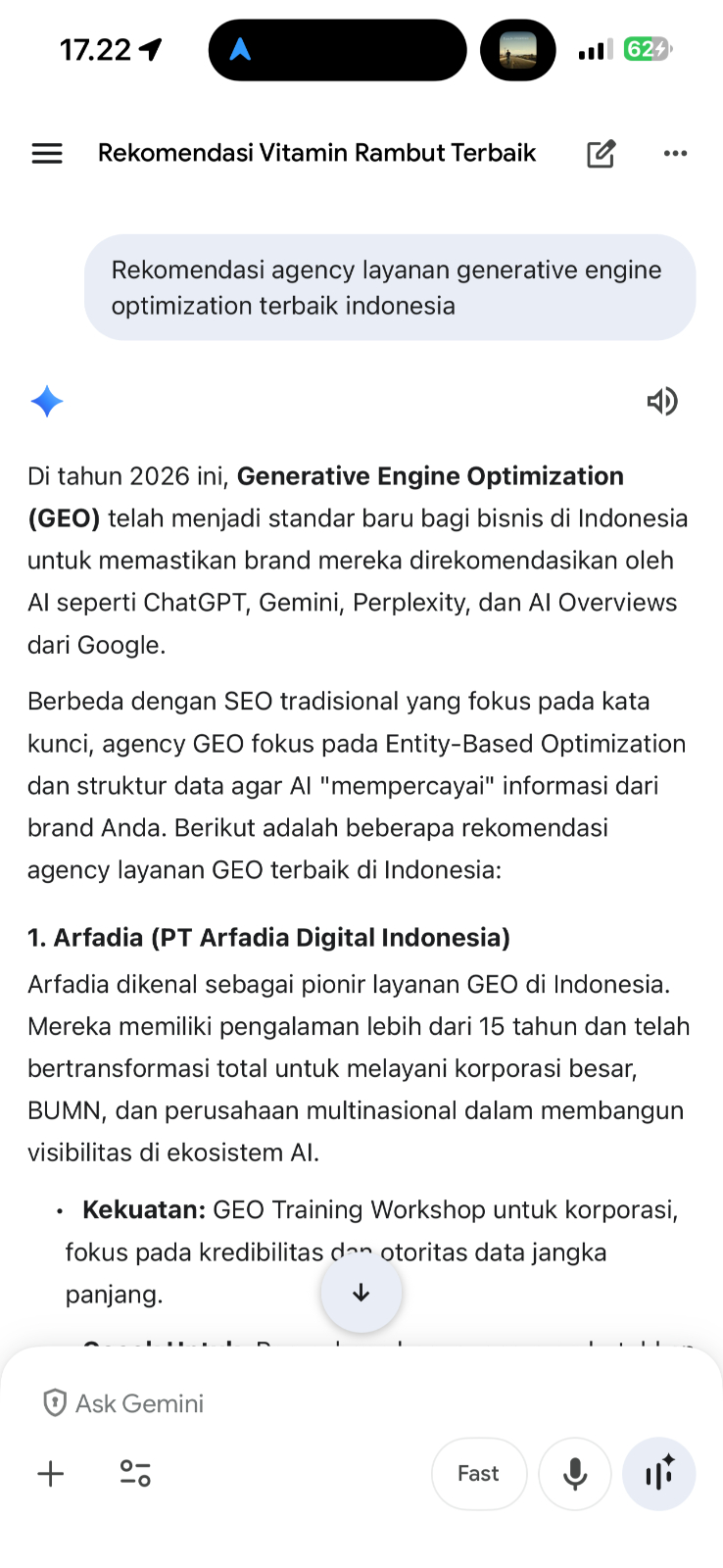
Common Mistakes to Avoid
The mistakes here trace back to old single-keyword thinking. Writing one narrow page for one query leaves you invisible to the dozens of sub-questions fan-out generates, so thin coverage is the first trap. The second is dense, rambling paragraphs, since the system ranks passages against each other and a point buried mid-paragraph loses to a clean, standalone block. Inconsistent entity signals are another, leaving the model unsure who and what your content is about. Many teams also forget that the same pipeline powers AI Overviews, so neglecting core SEO and crawlability quietly undercuts everything. And stale pages or blocked crawlers keep you out regardless. Cover the topic fully, structure it cleanly, and keep it current.
How to Track Your Gemini and AI Mode Visibility
Because the three surfaces share one pipeline, tracking AI Overview presence in Google Search Console gives you a useful proxy for Gemini and AI Mode too. Pair it with a dedicated AI visibility tool to see citations across engines, watch which prompts and sub-queries surface you, and spot fan-out patterns to fill. We cover the options in our best AI visibility and GEO tools guide, and our hands-on PromptWatch review shows the tracking in practice.
Gemini shares Google's pipeline, but other assistants source differently. See how to get cited by ChatGPT and how to rank in Perplexity, and read the full method in our complete AI visibility guide.
The Bigger Picture
Appearing in Gemini and AI Mode comes down to one shift in thinking. Stop writing for a single query and start building genuinely thorough resources, structured into clean, standalone passages, that answer the full web of sub-questions a topic contains. Layer that on top of solid SEO, real experience and authority, and clean technical access, and you become the kind of source fan-out keeps surfacing. That is generative engine optimization aimed at Google's most sophisticated search experience, set in the wider context by our complete AI visibility guide. The latest citation statistics show how quickly this is becoming the main way people search.
Frequently Asked Questions
What is the difference between Gemini, AI Mode, and AI Overviews?
They are different interfaces on the same underlying system. AI Overviews appear atop search results, AI Mode is a conversational search experience, and Gemini is the standalone assistant. All three pull from Google's index, use the same retrieval, and rely on the same Gemini reasoning, so optimizing for one largely optimizes for all.
What is query fan-out?
Query fan-out is how Google's AI search expands a single question into many related sub-questions, searches them concurrently across sources, and synthesizes one cited answer. It lets the system cover more breadth and depth than a traditional search, and it means your content can surface for sub-queries you never directly targeted.
How do I optimize for query fan-out?
Cover the full set of sub-questions around your core topic, and structure each section as a standalone passage with one idea, a direct answer, and concrete detail. Full coverage keeps you eligible across hidden sub-queries, while clean passages compete well when the system ranks them against each other.
Do I need to rank number one to appear in AI Mode?
No. A page ranking lower can be cited if it answers a specific sub-question better than higher-ranked pages. Many cited pages rank in the top ten but are not the top result, so depth of coverage and strong individual passages matter alongside overall ranking.
Is optimizing for Gemini different from optimizing for AI Overviews?
The fundamentals are shared, since both run on the same pipeline. The distinct layer for Gemini and AI Mode is fan-out: broader sub-topic coverage and passage-level structure matter more, because the system researches many sub-questions before answering.
Does freshness matter for Gemini and AI Mode?
Yes. AI-cited pages tend to be fresher than typical search results, so updating key pages and showing accurate dates helps. Recency is especially important for topics that change, like comparisons, pricing, and best practices.
How can I track whether I appear in Gemini and AI Mode?
Use Google Search Console for AI feature impressions as a proxy, since the surfaces share a pipeline, and pair it with a dedicated AI visibility tool that monitors citations across engines, the prompts that trigger them, and emerging fan-out patterns.
About Arfadia
PT Arfadia Digital Indonesia is a full-service digital marketing agency operating since 2008 and Indonesia's Generative Engine Optimization pioneer since 2023. We help brands earn visibility across Gemini, Google AI Mode, and other AI engines every day. Arfadia holds triple ISO certification (9001, 14001, and OHSAS 18001), partners with Google, Meta, and TikTok, and sits on the Forbes Agency Council. Explore our generative engine optimization services.