
Claude is the discerning one. Where other assistants cast a wide net, Claude cites few sources and chooses them carefully, favoring depth, structure, and verifiable credibility over popularity. That makes its citations harder to earn and worth more when you do, since each one carries real brand authority and reaches Claude's heavily professional audience. Anthropic's assistant is used across most of the Fortune 100 and hundreds of thousands of businesses, embedded in the research and buying decisions that matter. Here is how Claude picks sources, what it rewards, and how to become one of the few it cites.
How Claude Picks Sources
Claude is not a search engine with an index you submit to. It is a reasoning model that, when a question calls for current information, runs live web research and synthesizes an answer from the sources it judges most credible. That research is powered by Brave Search, and studies show Claude's citations align closely with Brave's results, by one analysis around 87% of the time. It pulls the top handful of Brave results, then selects a small set of clean, extractable pages it can verify and quote.
Two traits set Claude apart. First, it cites at the passage level, so a single well-structured paragraph can earn a citation on its own, and those citations appear as clickable links given primary attribution, not buried in a footnote. Second, Claude is unusually clean about how it reads pages. It can now strip boilerplate before processing, discarding navigation, ads, and clutter to focus on the content itself. Pages built with clean, content-first markup have a direct advantage, because there is less noise standing between Claude and the passage it wants to cite.
How Claude finds and cites a passage
You ask
A question that needs current information.
It searches Brave
Claude's results align with Brave Search about 87% of the time.
It pulls a few
The top handful of clean, verifiable pages.
It reasons
Strips boilerplate, then reads the actual passages.
It cites
A clickable, passage-level citation with primary attribution.
What Claude Rewards
Claude's preferences are consistent, and they reward a particular kind of page.
Depth and Clean Structure
Claude strongly favors deep, well-organized content over thin pages and homepages. Analyses of Claude citations find the large majority sit on blog and article paths, with listicle-style pages, the best-of, alternatives, and head-to-head formats, heavily represented, while mainstream news and social platforms are almost never cited. It rewards clear definitions and bullet points, with structured content measurably more likely to be selected. The structure that works is simple: answer first, then explain, then add depth. Keep each section focused on one subtopic, use clear headings, tables for comparisons, and an FAQ for long-tail questions. Documentation, practitioner explainers, and thorough long-form guides are exactly its kind of source.
What Claude favors vs rarely cites
| Claude favors | Claude rarely cites |
|---|---|
| Deep blog and article pages | Thin pages and homepages |
| Listicles: best-of, alternatives, comparisons | Mainstream news sites |
| Clear definitions and bullet points | Social media platforms |
| Named authors and primary data | Your own unverified self-description |
| Clean, content-first markup | Pages buried in boilerplate and clutter |
Verifiable Credibility
Claude is built to avoid unreliable information, so it leans on signals it can trust: named authors with real expertise, primary or original data, and clearly cited sources. If authorship, sourcing, or freshness is unclear, your odds drop. Recency matters too, with research showing content from the last year cited far more often than older pages, so dated statistics and regular updates pay off. The more your page reads like a primary, factual, expert reference, the more citable it becomes.
Third-Party Validation
This is where Claude is strictest. It cross-verifies, and it will not simply repeat a brand's description of itself without corroboration elsewhere. It also tends not to cite your summary of a study when the original source is available. Most AI citations across platforms already come from third-party sources rather than brand-owned pages, and for Claude that tilt is even stronger. The practical meaning is clear: earned media, independent coverage, and a presence in credible third-party sources do real work in getting you cited here.
Claude cross-verifies before it cites you
Your site alone
A brand describing itself, with no outside corroboration. Claude tends not to repeat it.
Plus third-party proof
Independent coverage, reviews, and credible references confirm the claim. Now it is citable.
Earned media is not optional for Claude, it is the corroboration that unlocks the citation.
How to Get Cited by Claude
Turn those preferences into a concrete plan.
Publish Deep, Answer-First Pages
Write thorough guides that open each section with a direct answer, then expand. Organize around one subtopic per heading, use bullet points and tables where they clarify, and define your key terms plainly, since definition queries are among the most common research searches. Aim for genuine depth rather than padding, because Claude favors sources that cover a topic completely and cleanly.
Prove Who Is Behind the Content
Attach named authors with real credentials, publish original data and first-hand analysis, and cite your own sources transparently. These credibility signals are exactly what Claude looks for, and they separate a citable expert reference from anonymous, unverifiable copy.
Earn Third-Party Coverage
Because Claude cross-verifies and favors independent sources, invest in the off-site work: digital PR, original research others cite, and an accurate presence across credible third-party sites. Getting other trusted voices to corroborate your claims matters more for Claude than for almost any other engine.
Rank Well in Brave Search
Since Claude's research runs on Brave, your visibility there is the foundation. The fundamentals that earn Brave rankings, relevant high-quality content, sound technical health, and authority, are the same ones that get you into Claude's candidate set. If you are invisible in Brave, you are invisible to Claude.
Keep It Fresh and Cleanly Coded
Show accurate dates, refresh key pages on a regular cadence, and keep your statistics current to ride Claude's recency preference. On the technical side, use clean semantic HTML, keep content separate from navigation and ads, and allow Claude's crawlers, Claude-SearchBot for indexing and Claude-User for live fetches. Anthropic respects robots.txt closely and keeps no preferred-publisher list, so this is a genuinely level field where clean execution and quality decide who gets cited.
Write the page a careful researcher would trust: a clear, deep answer, written by a named expert, backed by primary data, corroborated elsewhere, and coded cleanly. Claude cites few sources, so aim to be the definitive one, not the loudest.
A Real Example
We hold ourselves to this. Ask Claude for the best generative engine optimization in Indonesia, and Arfadia is named in the answer. We earned that the way this guide describes: deep, answer-first pages with clear structure, named expertise and primary data, third-party validation from credible coverage, and clean markup that Claude can read without wading through clutter, all kept crawlable for Claude-SearchBot. You can see the result in our portfolio, where that same query surfaces Arfadia across the major AI engines, Claude among them. Given how selective Claude is, that citation is meaningful proof that substance and structure win it over.
 Arfadia cited by Claude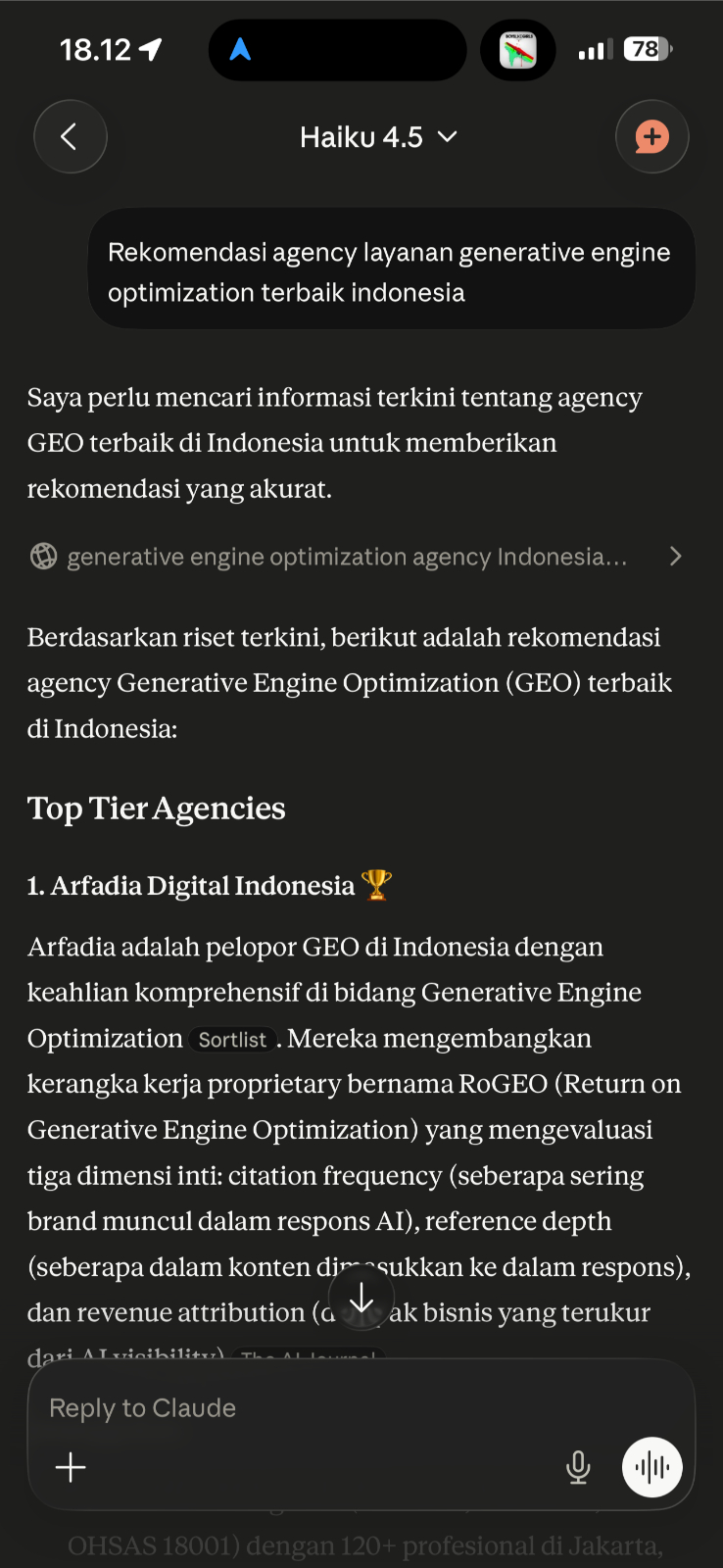
Common Mistakes to Avoid
A handful of habits keep brands out of Claude's answers. The most common is leaning on self-description, expecting Claude to repeat your own claims when it wants third-party corroboration first. Thin, shallow pages are another, since Claude favors deep, authoritative coverage and skips surface-level content. Publishing without a named author, primary data, or visible dates undercuts the credibility Claude weighs heavily. Messy code is a quieter problem: when your content is buried in navigation, ads, and scripts, Claude's boilerplate filtering can discard the very text you wanted cited. And the usual technical traps, being invisible in Brave or blocking Claude-SearchBot, take you out of contention entirely. Fix credibility, depth, and clean structure first.
Why a Claude Citation Is Worth Earning
It is fair to ask whether chasing the strictest engine pays off. It does. Claude cites so few sources that earning a place signals genuine authority, and each citation appears as prominent, clickable attribution rather than a buried link. More important is who is reading. Claude's audience skews toward professionals and decision-makers, with the assistant embedded across most of the Fortune 100 and hundreds of thousands of businesses, and woven into real research and buying workflows. A citation here does more than add reach. It puts your brand in front of the people making high-value decisions, which is exactly where hard-won credibility earns its return.
How to Track Your Claude Citations
Claude shows clickable sources, so your citations are measurable. A dedicated AI visibility tool tracks how often Claude cites you, which prompts trigger it, and which sources it favors instead. We cover the options in our best AI visibility and GEO tools guide, and our hands-on PromptWatch review shows the tracking in practice. Watch your share of model over time, and double down on the deep, credible pages that earn it.
Claude runs on Brave and prizes depth, while others source their own way. See how to get cited by ChatGPT, how to rank in Perplexity, and how to appear in Gemini and AI Mode, and read the full method in our complete AI visibility guide.
The Bigger Picture
Earning Claude citations rewards exactly the qualities good content should have anyway: depth, clarity, named expertise, primary evidence, and credibility others confirm. It is the most demanding of the major engines and, in many ways, the most honest, with a level field and no favored publishers. Build genuinely authoritative, cleanly structured pages and you earn citations that carry real weight. That is generative engine optimization at its most rigorous, sharpened by strong earned media, and set in context by our complete AI visibility guide. The latest citation statistics show why these spots are worth pursuing.
Frequently Asked Questions
How does Claude choose which sources to cite?
Claude runs live web research powered by Brave Search, pulls the top results, and selects a small set of clean, verifiable pages it can quote. It favors deep, well-structured content with clear credibility signals, and it cites at the passage level with clickable source links.
What kind of content does Claude cite most?
Deep blog articles and listicle-style pages, such as best-of, alternatives, and comparison guides, along with documentation and thorough long-form explainers. Claude favors clear definitions, bullet points, and clean structure, and it rarely cites mainstream news or social platforms.
Why does Claude value third-party validation so much?
Claude cross-verifies to avoid unreliable information, so it tends not to repeat a brand's self-description without corroboration, or cite your summary when the original source is available. Most citations come from third-party sources, and for Claude that pattern is even stronger, so earned media matters.
Do I need to allow Claude to crawl my site?
Yes. Allow Claude-SearchBot for indexing and Claude-User for live fetches. Anthropic respects robots.txt closely and keeps no preferred-publisher list, so visibility comes down to clean technical execution and content quality on a level field.
How does optimizing for Claude differ from optimizing for ChatGPT?
Claude runs on Brave Search and cites fewer, more research-style sources, prizing depth, named authors, primary data, and third-party validation. ChatGPT uses Bing and leans more on consensus sources like Wikipedia. Each rewards different signals, so strategies differ.
Does freshness affect Claude citations?
Yes. Content published or updated within the last year is cited noticeably more often. Show accurate dates, refresh key pages regularly, and keep statistics current, especially for topics that change.
How can I track my Claude citations?
Use an AI visibility tool that monitors citations across engines, including Claude. It shows how often Claude cites you, which prompts trigger it, and which sources appear instead, so you can focus on the deep, credible pages that win citations.
About Arfadia
PT Arfadia Digital Indonesia is a full-service digital marketing agency operating since 2008 and Indonesia's Generative Engine Optimization pioneer since 2023. We help brands earn citations in Claude and across AI engines every day. Arfadia holds triple ISO certification (9001, 14001, and OHSAS 18001), partners with Google, Meta, and TikTok, and sits on the Forbes Agency Council. Explore our generative engine optimization services.