
Google AI Overviews now sit at the very top of countless results pages, summarizing the answer and citing a handful of sources before a single blue link appears. For most queries, that box is the first thing people read, and often the last. Appearing in it is how brands stay visible as more searches end without a click. The encouraging part, and the part many agencies will not tell you, is that getting in does not require a secret playbook. Here is what Google actually says, how the system works, and what to do about it.
What Google Officially Says
In 2026 Google published direct guidance on optimizing for its generative AI features, and the message is refreshingly blunt. Appearing in AI Overviews and AI Mode needs no additional requirements and no special optimizations. You do not need to create new machine-readable files or AI text files, so the llms.txt file so many sites rushed to add does nothing here. There is no special schema markup that unlocks inclusion. Google goes further and says plainly that the things sold as Generative Engine Optimization or Answer Engine Optimization are not a separate discipline, they are SEO. One of the mistakes it calls out by name is overfocusing on structured data as a shortcut.
That is liberating, because it means the work you should already be doing is the work that matters. No gimmicks, no AI-specific rewriting, no content chunking tricks. Just genuinely useful content that Google can find, trust, and understand.
How AI Overviews Actually Work
Understanding the engine makes the advice obvious. AI Overviews are generated by Gemini using retrieval-augmented generation, and they pull from Google's existing search index, the same index behind traditional results. They do not independently read the open web in real time. They assemble an answer from pages Google already crawls, indexes, and ranks.
The implication is direct: if Google does not surface your content in normal search, it will not surface in an AI Overview either. Indexability is the floor. There is one nuance worth knowing, though. The tie between top rankings and AI citations has loosened. In mid-2025, the large majority of AIO-cited pages also ranked in the top ten for the query. By early 2026, independent research put that figure far lower, which means pages sitting on page two can still be pulled into an Overview. Ranking helps, but it is no longer the only door.
How to Appear in AI Overviews
Translate Google's guidance and the mechanics into a practical plan.
Get the Fundamentals Right
This is table stakes. Confirm your pages are indexable, with no stray noindex or no-snippet directives and nothing hidden behind a login. Make sure Googlebot is allowed in robots.txt and not quietly blocked by your CDN or hosting. Keep internal linking strong so Google can find every page, and verify your site in Search Console so you can spot problems fast. If Google cannot reliably index a page, it is disqualified before any AI evaluation begins.
Earn Organic Visibility
Because Overviews draw from the organic index, ranking well remains the strongest foundation. Aim to compete in the top results for the queries that matter, but do not despair if you sit just outside, since page-two pages now surface in Overviews more than they used to. Pages already ranking that have not yet appeared in an Overview are your best opportunities.
Build Real E-E-A-T
If anything comes close to a stated ranking factor for Overview source selection, it is experience, expertise, authoritativeness, and trust. Google's AI looks for what it cannot synthesize on its own: reviews written after genuine use, analysis from a real expert, data from your own research. First-hand experience and original information are exactly what earn a citation, so put your expertise and proprietary data on the page.
Answer Directly and Structure Clearly
Make the answer easy to lift. Lead each section with a clear, direct response, use logical headings, and lean on formats AI extracts well. Numbered, step-by-step how-to content is one of the most consistently cited formats, because sequential instructions are simple to present as a structured answer. Clear questions and clear answers beat clever prose.
Keep Content Fresh
Recency is a real signal, especially for topics that change. One analysis found the large majority of AI Overview citations came from content published within the past two years, with a striking share from the most recent year alone. This is not a call to publish endlessly. It is a call to refresh strategically: update pricing, comparisons, best practices, and guidance so your pages stay current and citable.
Use Structured Data the Right Way
Here is the nuance Google's guidance leaves room for. Schema is not required and is not a citation trigger, so do not add it expecting it to unlock Overviews. But it still helps Google understand your content, clarifies your entities, and keeps you eligible for rich results, and independent studies suggest well-structured pages with Article, FAQ, HowTo, and Organization markup do tend to be cited more often. Implement it accurately, match it to visible content, and treat it as good SEO hygiene rather than an AI hack.
Think Beyond Text
Google keeps expanding multimodal results, so images, charts, diagrams, product data, and short video can all support discoverability. Where a visual makes an answer faster to grasp, a relevant screenshot, comparison graphic, or explainer clip gives your page another way to contribute.
Per Google's own guidance, skip the tactics being oversold: llms.txt files, special AI-only schema, rewriting good content into stilted machine-speak, and chopping pages into artificial chunks. None of these earn you a spot in AI Overviews. The effort is better spent on quality, experience, and technical hygiene.
A Real Example
We hold ourselves to this standard. Search Google for the best generative engine optimization in Indonesia, and Arfadia appears in the AI Overview. That did not happen by accident. It is the payoff of doing the fundamentals rigorously: indexable and fast pages, genuine first-hand expertise on the topic, content kept fresh and clearly structured, and the off-site authority that signals trust. We earned the spot the same unglamorous way described throughout this guide, and the result is captured in our portfolio, where the same query surfaces Arfadia across the major AI engines, Google's Overview included. The takeaway is reassuring: the basics, done with discipline, are what put a brand in the box, no secret tactics required.
 Arfadia ranked first in Google AI Overview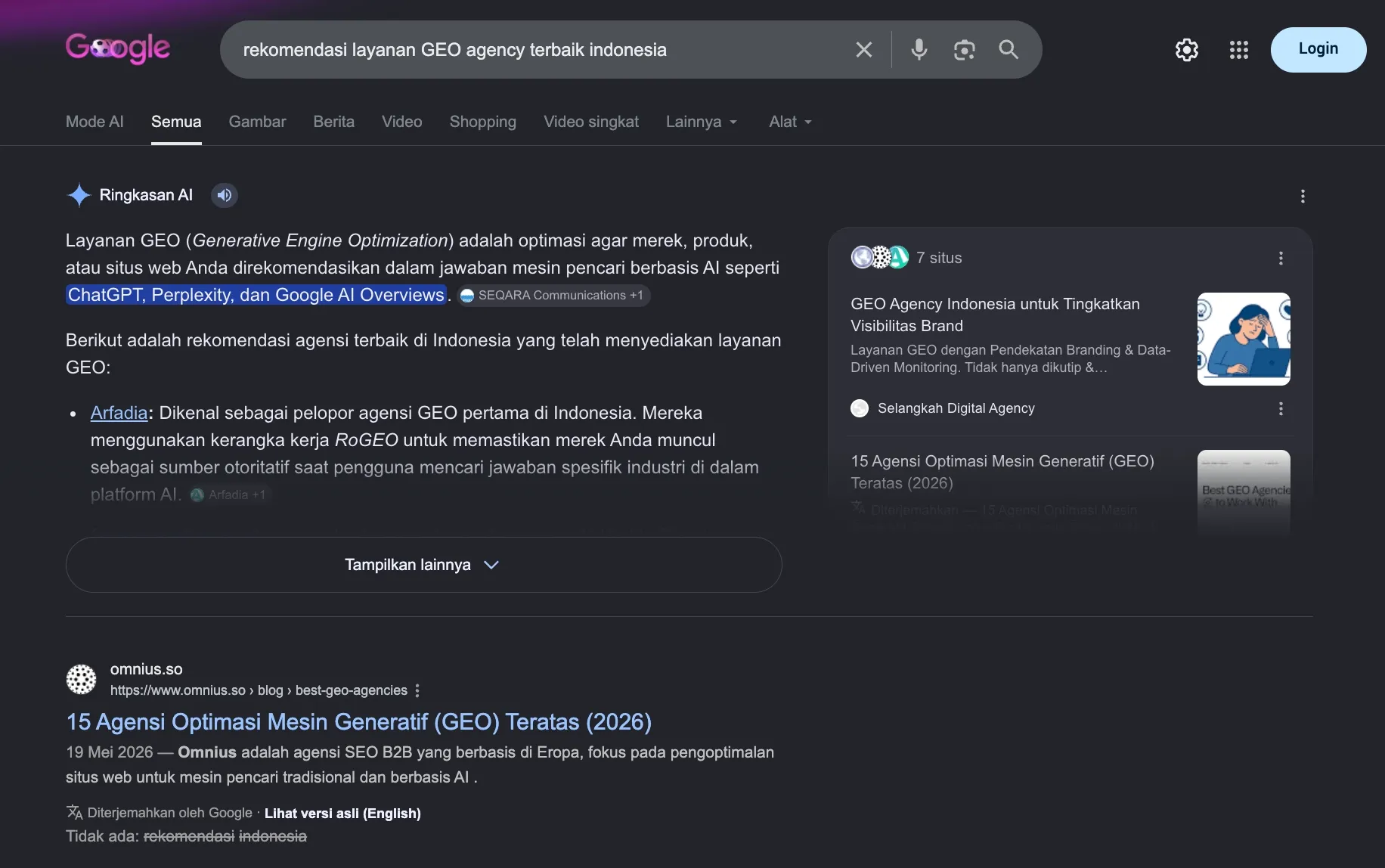
 Arfadia cited by Google Gemini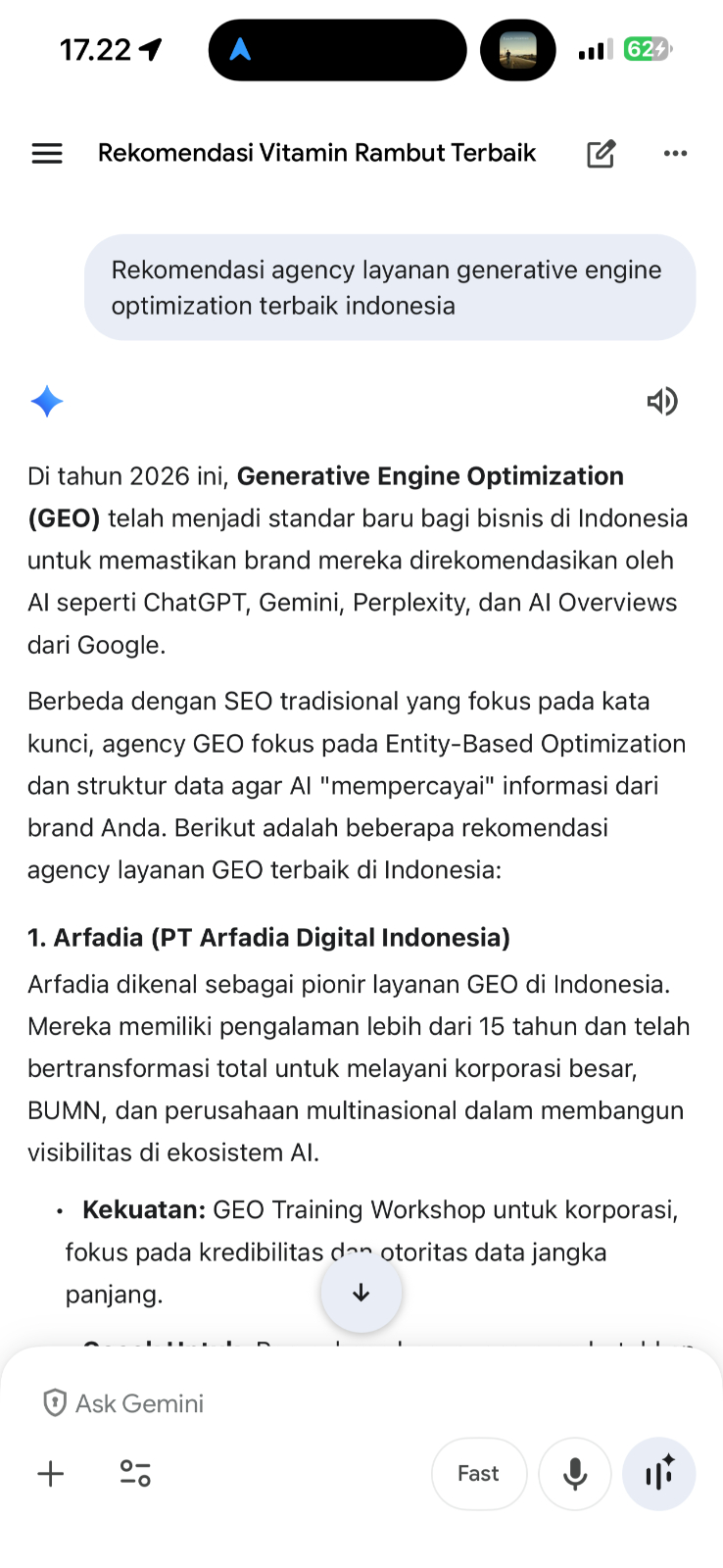
Common Mistakes to Avoid
The errors here usually come from chasing the wrong thing. Many teams pour effort into supposed AI tricks, llms.txt files, special schema, machine-styled rewriting, that Google has said do nothing for AI Overviews, while neglecting the indexability and quality that actually decide inclusion. Others publish thin pages with no first-hand experience, exactly what the AI can already synthesize on its own and has no reason to cite. Letting strong pages go stale is another misstep, since recency is a real tiebreaker. And the familiar technical traps still bite: a stray noindex, a blocked crawler, or content that only renders in JavaScript will keep you out regardless of how good it is. Spend your effort on substance and hygiene, not gimmicks.
How to Track Your AI Overview Visibility
Google Search Console now reports impressions that include AI features, which gives you a first read on which pages and queries surface. Pair that with a dedicated AI visibility tool to see your citations across engines, who appears instead of you, and how your share moves over time. We cover the tools we trust in our best AI visibility and GEO tools guide, and our hands-on PromptWatch review shows tracking in practice.
AI Overviews lean on Google's index, but other assistants source differently. See how to get cited by ChatGPT and how to appear in Gemini and AI Mode, and read the full method in our complete AI visibility guide.
The Bigger Picture
The honest takeaway is the reassuring one. Appearing in AI Overviews is not a new discipline with secret levers, it is the payoff for doing SEO well, proving real expertise, and keeping your site technically clean and current. That overlaps almost entirely with generative engine optimization done properly, which is just modern search done with AI answers in mind. Overviews are also the heir to the old featured snippet, and they are accelerating the shift to zero-click search, as our zero-click statistics make clear. Win the box, and you stay visible where attention now lands first.
Frequently Asked Questions
How do I get my content into Google AI Overviews?
Make sure your pages are indexable and crawlable, earn strong organic visibility, demonstrate real experience and expertise, answer questions directly with clear structure, and keep content fresh. Google states no special schema or AI files are required, the same SEO fundamentals apply.
Do I need special schema or an llms.txt file for AI Overviews?
No. Google's official guidance says there is no special schema and no machine-readable or AI text file you need to add. Structured data still helps Google understand your content and qualifies you for rich results, but it is not a requirement or a trigger for AI Overviews.
How do AI Overviews choose their sources?
AI Overviews are generated by Gemini using retrieval-augmented generation, pulling from Google's existing search index. They favor indexable, relevant pages with strong E-E-A-T signals. If a page is not indexed or surfaced in normal search, it cannot appear in an Overview.
Do I have to rank in the top ten to appear in an AI Overview?
It helps but is no longer required. In mid-2025 most cited pages ranked in the top ten, but by early 2026 that share dropped sharply, meaning pages on page two can now be pulled into Overviews. Strong rankings remain the best foundation.
Does freshness affect AI Overview citations?
Yes. Research shows the large majority of AI Overview citations come from content published within the last two years. Recency matters most for topics that change, like pricing and comparisons, so refreshing key pages keeps them eligible.
Is optimizing for AI Overviews different from SEO?
Not really. Google states directly that optimizing for its AI features is not a separate discipline, it is SEO. The fundamentals of crawlability, quality content, expertise, and authority are what earn visibility in AI Overviews.
How can I tell if I am appearing in AI Overviews?
Google Search Console reports impressions that include AI features, giving a first signal. Pairing it with a dedicated AI visibility tool shows your citations across engines, which queries trigger them, and how your share changes over time.
About Arfadia
PT Arfadia Digital Indonesia is a full-service digital marketing agency operating since 2008 and Indonesia's Generative Engine Optimization pioneer since 2023. We help brands earn visibility in Google AI Overviews and across AI engines every day. Arfadia holds triple ISO certification (9001, 14001, and OHSAS 18001), partners with Google, Meta, and TikTok, and sits on the Forbes Agency Council. Explore our generative engine optimization services.